Quick answer
- First-timers, families, flat water: Book the dry season (December to April) — calmest seas, 30m-plus visibility on the best days, easy Male arrival.
- Divers and big pelagics: Book the wet season (May to October) — nutrient-rich water and the Hanifaru Bay manta aggregations in Baa Atoll, which peak in the July to October part of the wet season.
- Golden routing rule: Plankton, and the mantas that feed on it, gather on the downwind side of each atoll — so your captain shifts west or east with the monsoon.
- Best value: November and April shoulder months — near-peak conditions, softer rates, fewer boats on the same dive sites.
- The boat: A 30 to 60m motor yacht with dive support is the realistic Maldives vessel. Crewed sailing catamarans are scarce here.
- Book ahead: 8 to 12 months for peak dry season; 5 to 7 months for Baa Atoll manta season.
For most first-time Maldives charter guests, we recommend the dry season, December to April. You get the calmest crossings between atolls, the best snorkelling visibility of the year, and the simplest arrival logistics out of Male. We steer divers and anyone chasing manta rays and whale sharks toward the wet season instead — May to October — when nutrient-rich water pulls big pelagics in, especially around Hanifaru Bay in Baa Atoll.
The real question is not “which month is best” in the abstract. It is what you actually want to do in the water, and how much motion at anchor you are willing to accept. That is what changes between the two seasons, and it changes more than most people expect.
 John Boullin, Charter Broker at DMA Yachting
What actually changes between the seasons
The Maldives runs on two monsoons. The northeast monsoon (December to April) brings the dry season: calm seas, low humidity, and visibility that can reach 30m-plus on the best days. The southwest monsoon (May to October) brings the wet season: warmer, greener water, occasional squalls, and visibility that can drop to 10 to 15m in exposed areas.
| Season | Best for | Not ideal for | Water & sea |
|---|---|---|---|
| Dry (Dec–Apr) | First-timers, families, snorkelling, flat anchorages | The biggest manta aggregations, lowest rates | Calm seas, 30m-plus on the best days |
| Wet (May–Oct) | Diving, Hanifaru Bay mantas, surfing, value | Nervous sailors, pure sunbathing weeks | Occasional swell, 10–15m in exposed areas |



The rule that decides your route
The plankton, and the mantas, move with the monsoon
This is the single most useful thing to understand before you book. Prevailing winds tend to push plankton toward the downwind side of an atoll, and manta rays feed where that plankton concentrates. During the dry season, when winds blow from the northeast, that feeding action often sits on the western side of the atolls. During the wet southwest monsoon, it tends to flip toward the eastern side — which is exactly why Baa Atoll’s Hanifaru Bay, on the eastern edge of the archipelago, comes alive in the wet season.
It is a tendency, not a timetable. Local currents and each atoll’s shape matter, so a good captain reads the water in front of them rather than following a fixed map.
 Susannah Deehan, Charter Broker & CYBA Member at DMA Yachting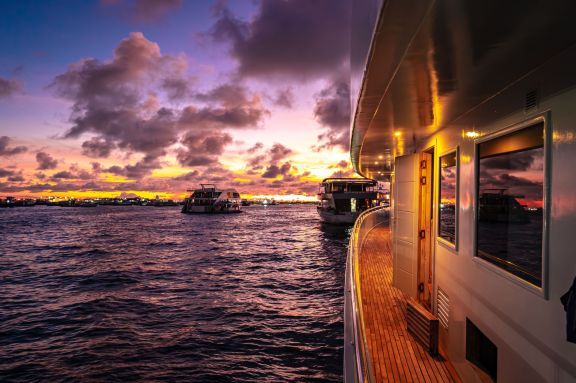
Who should book the dry season
Book December to April if this is your first crewed charter, you are travelling with children or non-divers, or your week is really about flat-water snorkelling, sandbanks and swimming off the transom. The North and South Male atolls make an easy starting area — short transfers from the airport, plenty of protected anchorages, and resort-style options nearby if you want them.
December to March is the true peak, with the highest visibility, the calmest seas and the highest rates. If you want near-peak conditions without peak crowds, November and April are the shoulder months we point people toward most often. You can browse the current Maldives charter fleet to see what is holding availability in your window.
Who should book the wet season
Book May to October if you are diving-led or you specifically want the big-animal encounters. This is the manta window, and Hanifaru Bay in Baa Atoll — a UNESCO Biosphere Reserve — draws the largest aggregations. The plankton blooms that trigger them build through the wet season and typically peak from July into October, which is why the manta season is often described as running a little past the calendar end of the monsoon. South Ari Atoll holds a largely resident whale shark population that is present year-round; sightings there are strong across seasons. Sites like Maaya Thila come into their own for divers.
The tradeoff is honest: you will see rain, some anchorages get lumpier, and visibility varies day to day. But the water is warm, the Maldives sits outside the cyclone belt, and rates and availability are softer. It suits divers, surfers heading for breaks like Cokes or Chickens, and anyone who cares more about what is under the boat than a perfectly cloudless week. Prioritise a yacht set up for diving with compressors and multiple tenders.
 Miles Froelicher, Charter Broker at DMA Yachting
The boat matters more than the month
The Maldives charter fleet is small and motor-yacht dominated — think 30 to 60m purpose-built liveaboards with dive support, tenders and the range to move across the atolls. Crewed sailing catamarans are genuinely scarce here; if you have your heart set on one, we will usually redirect you toward a well-equipped motor yacht or a power catamaran, because that is what actually operates in these waters.
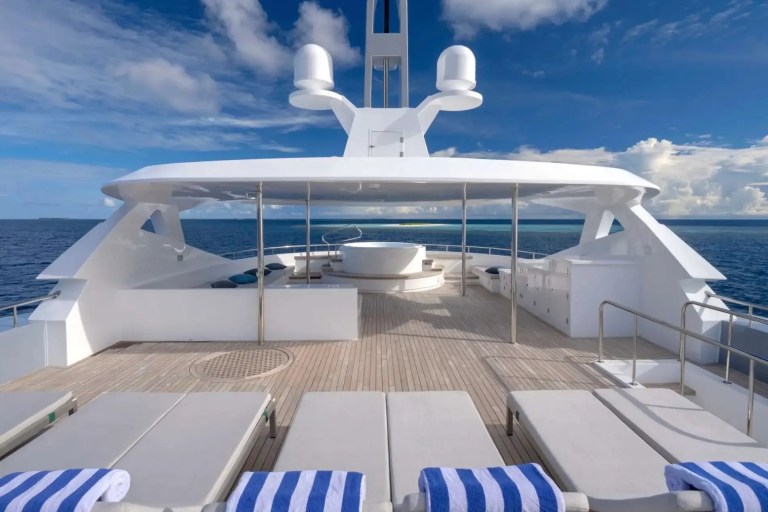
To picture the larger end of the fleet, a vessel like a 55m Trinity motor yacht sleeps up to 12 guests in 6 cabins and turns the whole archipelago into your itinerary. Availability of any specific yacht changes constantly, so treat the example below as illustrative — we will confirm what is genuinely free in your dates before you commit.
On rates, the crewed luxury fleet here spans roughly from the low tens of thousands per week for smaller yachts up to well over $200,000 per week for the largest platforms, before expenses. If your group is smaller or the budget sits lower, ask about the smaller luxury yachts in the fleet; if you want the whole archipelago at your disposal, we point you at the larger motor yachts. On top of the base fee, expect Maldives goods and services tax, a green environmental tax charged per guest per night, cruising permits, an advance provisioning allowance for fuel and provisioning, and crew gratuity. These government rates change from time to time, so we confirm the current figures in writing on every quote rather than relying on a published number. A 7-night program covers one atoll region well; 14 nights lets you run a proper dive-heavy circuit.
FAQ
Is the wet season a bad time for a Maldives charter?
No — it is the better time if you dive. You accept some rain and lower visibility, but you gain the Hanifaru Bay manta season, strong whale shark encounters at South Ari, softer rates and fewer boats. It is a poor choice only if your week is purely about flat water and unbroken sun.
Which month gives the best value?
November and April. Both sit at the edge of the dry season with near-peak conditions but softer rates — the sweet spot for guests who want peak-quality water without peak pricing.
How far ahead should I book?
For the peak dry season (December to April), reserve 8 to 12 months before you sail — the fleet is small and fills early. For Baa Atoll manta season, 5 to 7 months ahead gives you the best choice of vessel.
Can I see manta rays in the dry season too?
Yes. From December to April the mantas tend to feed on the western side of the atolls, following the plankton downwind of the northeast monsoon. The famous Hanifaru Bay aggregation in Baa Atoll is a wet-season event, but manta rays are present year-round — your captain just moves you to the right side of the atoll for the season.
Should I hold out for a sailing catamaran?
We would not build a Maldives trip around one. Crewed sailing cats are rare here and hard to source. A 30 to 60m motor yacht or a power catamaran with proper dive support is the realistic — and better-equipped — option for these waters.
Plan Your Maldives Charter With Real Experts
Tell us how you like to travel and our charter team will hand-pick the right crewed yachts, dates and route — no obligation.
Our Top Maldives Recommendations
We put these shortlists together because most travellers don’t need to weigh up every yacht on the water — just the handful that consistently get this kind of trip right. Each guide below digs into the boats, the best months to go, and the trade-offs worth knowing before you book.



















 iMessage
 WhatsApp




































