Quick answer
- Best months overall: November through April, the northeast monsoon, for calm seas and the clearest water on the eastern reefs.
- Manta season: May through October, when the southwest monsoon pushes plankton-rich water into Hanifaru Bay in Baa Atoll and manta rays gather to feed.
- Best first-charter route: North Malé, South Malé and Ari atolls, all a short run from Velana International Airport.
- Best for a second or third trip: Vaavu, Huvadhoo and the far northern atolls (Haa Alif, Haa Dhaalu), for quieter channels and fewer boats.
- Vessel reality: the Maldives fleet is built around motor yachts and superyachts. Sailing catamarans are scarce here and usually have to be sourced elsewhere.
- Charter length: 7 nights covers 1 region properly; 10 to 14 nights lets you combine a northern or southern run with time around Malé.
For most first-time guests, we build the Maldives charter around North Malé, South Malé and Ari atolls between November and April. That window has the calmest crossings, the clearest water for diving and snorkeling, and the shortest run from Velana International Airport to the boat. If you’re chartering specifically for the manta and whale shark aggregation at Hanifaru Bay in Baa Atoll, the calendar flips: you want May through October, even though the sea is less settled, because that’s the window when the southwest monsoon brings the plankton the mantas are feeding on.
The atoll you pick and the month you sail are the same decision, not 2 separate ones. Baa Atoll in January is a quiet reef system with resort traffic nearby. Baa Atoll in the middle of the manta season is one of the better manta encounters anywhere in the Indian Ocean. Ari Atoll works well across most of the year because its whale sharks off Maamigili are resident rather than seasonal, which is why it’s the atoll we point undecided guests toward first, and why we lean on it heavily in our Maldives yacht charter planning.
What trips this up more than anything else is guests deciding on the destination first and the reason second. If you tell us you want to see mantas feeding at close range, we’re going to steer you to Baa Atoll in the middle of the southwest monsoon, full stop, even if that means a bumpier crossing from Malé. If you tell us this is a family trip with mixed swimming ability and no strong wildlife target, we’re going to keep you in the calm, short-transfer waters of North Malé, South Malé and Ari. Decide the reason first, then let us fit the calendar to it.
Season planning
When to charter: the northeast monsoon vs the manta season
The Maldives runs on 2 monsoons. The northeast monsoon, roughly November to April, brings dry weather, lighter wind and the best visibility on the atolls’ eastern edges. This is the season we recommend to guests chartering here for the first time, and it suits families and non-divers as much as it suits keen divers.
The southwest monsoon, roughly May through October, is wetter and the crossings between atolls get choppier. It’s also the season that feeds Hanifaru Bay. The nutrient-rich water the monsoon pushes toward Baa Atoll is what draws the manta rays and whale sharks that make it one of the more reliable large-animal encounters in the region. June through September also brings the swell that lights up North Malé’s surf breaks, if surfing is part of the brief.
April and October sit right at the hinge between the 2 monsoons, and we get asked about them often. Neither is a bad month, but neither is a clean choice either. April can still deliver settled northeast-monsoon conditions through most of the month, with the first hints of plankton starting to build in Baa Atoll toward the end of it, while October can offer a quieter, less crowded run as the southwest monsoon eases before the dry season fully sets in come November. We treat both as shoulder options for guests with flexible dates rather than the default recommendation for a first charter.
We don’t recommend building a charter around Hanifaru Bay and expecting northeast-monsoon sea conditions at the same time. You get 1 or the other. Decide why you’re chartering first, then let the month follow that reason rather than the other way around.


Best atolls for a first Maldives charter
North Malé and South Malé atolls are the easiest place to start. Velana International Airport sits inside North Malé, so transfer time to the boat is short, and both atolls mix sandbanks, snorkeling and resort-adjacent anchorages with genuinely good diving. South Malé adds strong drift dives in its channels for guests who want more current and more fish life than the postcard lagoons.
Ari Atoll is the next step out, and the one we send most repeat first-timers to. It has the broadest range of dive sites in the country, and the whale sharks off Maamigili are present year-round rather than tied to a single month, which takes the pressure off getting the calendar exactly right. Rasdhoo, on Ari’s northern edge, adds strong reef diving without pulling the itinerary far from Malé.
The run between North Malé and Ari is short enough that it doesn’t cost you a full cruising day, which matters more than it sounds. On a 7-night charter, every day spent repositioning is a day you don’t spend in the water, so the atolls that sit close together get more use out of a short itinerary than a wider spread ever will. That’s the practical reason, as much as the diving, that this trio anchors most first-time itineraries.
A 7-night charter covers North Malé, South Malé and Ari comfortably, with room to wait out a weather day or repeat a dive site that was good the first time. That’s the itinerary we default to for a first Maldives charter, family groups included. Big game fishing is another reason guests charter here, and it’s worth flagging at the brief stage, since it changes which grounds the captain prioritizes alongside the dive sites.
Baa Atoll and Hanifaru Bay: worth building the whole trip around
Baa Atoll is a UNESCO Biosphere Reserve, and Hanifaru Bay is the reason most guests go there. Between May and October, the southwest monsoon concentrates plankton in the bay and manta rays arrive to filter-feed, sometimes alongside whale sharks. It’s 1 of the few marine wildlife events reliable enough to plan an entire charter calendar around, in the same way we time wildlife-led trips in Raja Ampat.
Within that May-to-October window, May and October sit closer to the edges of the season and the encounters there can be hit or miss. The middle of the window, once the southwest monsoon is fully established, is where the aggregation is most consistent. If Hanifaru is the single reason you’re chartering, we usually steer guests toward the middle of the window rather than the shoulder months either side of it.
The bay is small and the aggregation can be dense, so access is managed to avoid crowding the mantas at the surface. That means your captain and guide need current, on-the-ground knowledge of how the site is being run day to day, and on busy days, some patience rather than motoring straight in. This is exactly the kind of operational detail that separates a crew who knows Baa Atoll well from one who is simply passing through, and it’s worth asking about directly when you’re comparing yachts for this route.
Outside May to October, Baa Atoll is still a decent reef system, but the aggregation thins out and there’s less reason to prioritize it over Ari or Vaavu. If Hanifaru isn’t the point of the trip, don’t route through Baa in February just to tick the atoll off.
Vaavu, Huvadhoo and the Northern Atolls: for a second or third trip
Vaavu Atoll suits guests who have done a Malé-area charter before and want a quieter, more liveaboard rhythm rather than resort-adjacent anchorages. Night dives with reef sharks and strong current-driven channel dives are the draws, and the atoll sees far less boat traffic than Ari.
Huvadhoo, in the deep south, and the far northern atolls of Haa Alif and Haa Dhaalu are expedition territory. Huvadhoo’s channels are known for serious shark diving and pelagic action, with almost none of the crowding you get further north. These atolls aren’t the place to start a first Maldives charter. The running time to reach them eats into a 7-night trip fast, which is why we send guests here once they already know what a Maldives charter feels like and want something quieter, closer in spirit to the way we position remote, less-traveled charter destinations generally.
The practical trade-off is time, not comfort. A yacht capable of reaching Huvadhoo or the far north comfortably will also handle the crossing well, so sea state usually isn’t the limiting factor. What limits the trip is how many hours you’re willing to spend repositioning instead of diving. On a 10 to 14 night charter that cost is easy to absorb; on a 7-night trip it usually isn’t, which is the main reason we hold these atolls back for guests booking a second or third Maldives charter rather than a first one.
| Atoll | Best season | Best for | Not ideal for |
|---|---|---|---|
| North Malé & South Malé | Year-round; calmest Nov–Apr | First charters, easy transfers, sandbanks, drift dives | Guests wanting remote, uncrowded reefs |
| Ari Atoll | Year-round whale sharks; calmest Nov–Apr | Broadest dive variety, resident whale sharks off Maamigili | Guests chasing 1 specific big-animal event |
| Baa Atoll | May–Oct for Hanifaru Bay | Manta and whale shark aggregations, snorkel-led wildlife | Nov–Apr trips expecting the same aggregation |
| Vaavu Atoll | Year-round; calmest Nov–Apr | Night dives, channel diving, quieter anchorages | First-time guests wanting resort-style stops |
| Huvadhoo & Northern Atolls | Nov–Apr for the longer runs | Serious shark diving, uncrowded expedition diving | Short 7-night trips, first-time charters |
Why yacht type matters as much as atoll
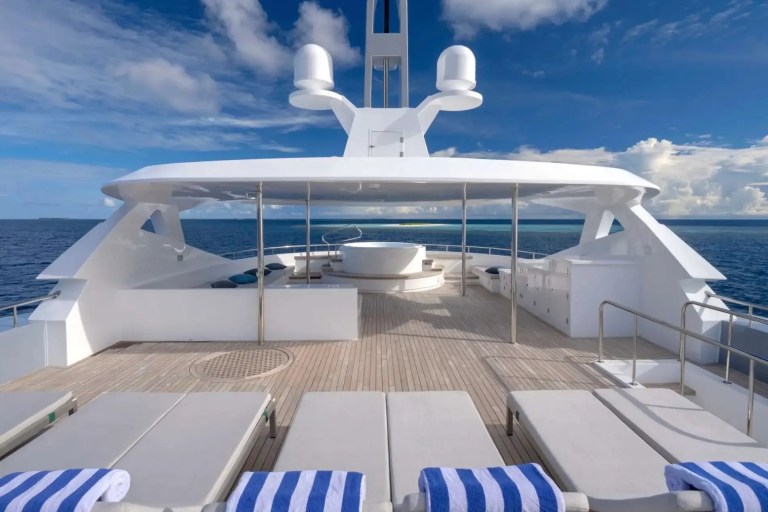
The Maldives charter fleet is small, around a dozen vessels set up for private charter, and it’s led by motor yachts and superyachts rather than sailing boats. That’s the opposite of what a lot of first-time guests expect walking in, and it changes how we plan the trip more than the atoll choice does.
Sailing catamarans are genuinely scarce here. If a catamaran is the non-negotiable part of your brief, we usually redirect that conversation toward Indonesia or the Thailand fleet, where catamarans are far easier to source, rather than holding out for limited Maldives availability. What the Maldives does well is a proper motor yacht with real dive support and enough range to cover 1 or 2 atolls without the boat becoming the limiting factor, something crewed charter here manages more comfortably than in Thailand, where the crewed motor yacht fleet is thinner.
Range and tender setup matter more here than in a lot of other destinations, because so much of the experience happens off the yacht rather than on it. A boat with a strong dive tender and a crew used to running Hanifaru Bay’s rules, or the atoll channels further south, will get you more time in the water than a bigger, more comfortable yacht with a less experienced crew. When we’re placing a family group against a serious diving group on the same style of trip, this is usually where the 2 briefs actually diverge, even if the atolls on the itinerary look identical on paper.
- Confirm whether your dates fall in the northeast monsoon (Nov–Apr) or the manta season (May–Oct), and pick the atoll to match.
- Ask early whether a catamaran is realistic for your dates. In the Maldives, a motor yacht is the honest default.
- If Hanifaru Bay matters to you, build the whole route around Baa Atoll rather than treating it as a side trip.
- Plan 7 nights for 1 region done well, 10 to 14 nights to combine Malé-area diving with a northern or southern run.
- Tell your broker if big game fishing matters. It shapes which grounds the captain prioritizes alongside the reefs.
How early should I book a Maldives charter?
For the peak northeast-monsoon window, November through April, we recommend booking as early as you can. The pool of Maldives-suitable motor yachts and superyachts is small, and the best boats for the popular weeks, especially over Christmas, New Year and the northern hemisphere’s spring holidays, go first. If your trip is centered on Hanifaru Bay, the same logic applies to the May-through-October window: boats with crews who know the bay well get quietly reserved well ahead of the season rather than once it’s already underway.
If your trip is coming up soon, it isn’t too late, but your choice of yacht narrows and you should expect less flexibility on the exact dates. We would rather move you a week earlier or later on a boat and crew we trust than squeeze you onto whatever happens to be free on your original dates. On a short lead time, we usually start by checking which yachts still have open weeks in North Malé, South Malé or Ari first, since that’s where availability holds longest, and treat Baa, Vaavu or the far atolls as a stretch goal rather than the starting point.
What is the best month for a Maldives yacht charter?
For most guests, November through April. That’s the northeast monsoon, with the calmest seas and clearest water for diving and snorkeling across North Malé, South Malé and Ari atolls.
When can I see manta rays at Hanifaru Bay?
May through October, during the southwest monsoon. The aggregation is centered on Baa Atoll and thins out considerably outside that window, so build the trip around those months if it’s the priority.
Can I charter a sailing catamaran in the Maldives?
Rarely, and not reliably. The Maldives fleet is dominated by motor yachts and superyachts. Guests set on a catamaran are usually better served in Indonesia or Thailand, where cats are far easier to source.
How many nights do I need for a Maldives charter?
7 nights covers 1 region, such as North Malé, South Malé and Ari, properly. 10 to 14 nights lets you add a northern or southern atoll run without rushing the crossings.
Which atoll is best for a first-time Maldives charter?
Ari Atoll, paired with North Malé and South Malé. Ari’s whale sharks off Maamigili are present year-round, and the transfer from Velana International Airport is short, which removes 2 of the biggest first-charter risks. See our full charter FAQ for booking timelines and planning questions.
Plan Your Maldives Charter With Real Experts
Tell us how you like to travel and our charter team will hand-pick the right crewed yachts, dates and route — no obligation.
Our Top Maldives Recommendations
We put these shortlists together because most travellers don’t need to weigh up every yacht on the water — just the handful that consistently get this kind of trip right. Each guide below digs into the boats, the best months to go, and the trade-offs worth knowing before you book.



















 iMessage
 WhatsApp




































