Quick answer
- Best for most families: a fully crewed private catamaran (up to 14 guests) — you own the timing, the chef, and the pace.
- Choose a small expedition ship if: your group is larger than a private catamaran can carry, and you’re happy to share the boat and sail on a fixed group schedule.
- Guide is mandatory: every boat carries a licensed naturalist and follows a park-approved eastern or western route — no free-roaming private itineraries in either case.
- Two worlds, two routes: the park runs itineraries as either eastern or western, not both in one week. To see both, you combine trips across back-to-back weeks.
- Private catamaran cost: shorter 5–6 day charters start around $54,000 (Sea Star, 5 days) and rise to roughly $125,000 (Galaxy Sirius, 6 days). Full-week rates across our listed Galápagos fleet run from about $63,225 to $650,000 depending on vessel and season.
Which suits Galápagos families: catamaran or expedition ship?
For most families, a fully crewed private catamaran wins. You get exclusive use of the boat, a chef cooking to your children’s tastes, and the freedom to linger at a snorkel site while the day’s schedule bends around your kids — not a shared passenger manifest. We only steer families toward a small expedition ship when the group is too large for a single private vessel, or when the lower per-person price of a shared cruise genuinely matters more than exclusivity.
The important thing to understand up front: in the Galápagos, neither option lets you invent your own route. Every yacht here operates a park-controlled eastern or western itinerary with a licensed naturalist onboard. The real choice is not “flexibility vs fixed” — it’s “private and intimate” vs “shared and scheduled.” For families, private nearly always feels better — but it is not always the better value, and we’ll be straight about where the ship makes sense.
 Chris de Kock, Charter Broker, Sales Broker, Active CYBA Member at DMA Yachting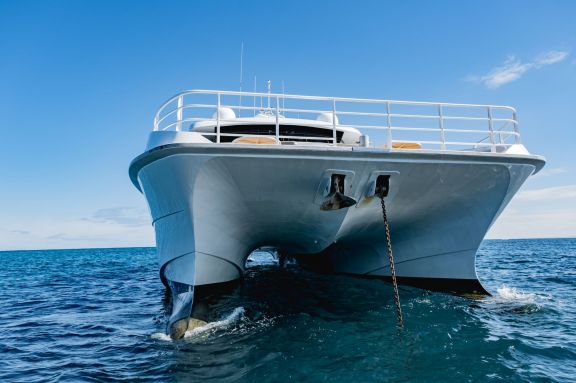
The differences that actually matter for kids
On a shared expedition ship, shore visits run on a group timetable. Tenders leave in waves, snorkel stops are timed, and a tired six-year-old still has to keep up with the schedule. Park rules cap shore groups at 16 people either way, but on a private catamaran that group is your group.
| Option | Best for | Not ideal for | Typical cost |
|---|---|---|---|
| Private crewed catamaran (up to 14) | Single or multi-gen families wanting exclusive use, private timing, kid-tailored menus | Groups too large for one boat; anyone chasing the lowest per-head price | ~$54k (5 days) to ~$125k (6 days); full week from ~$63,225 |
| Small expedition ship (shared) | Larger groups; cabin-by-cabin buyers happy to share the boat and follow a set schedule | Families wanting privacy, flexible mealtimes, unhurried snorkel stops | Per person; roughly $6k–$12k+ pp for 8 days at the luxury end |
Three things tip families toward the private cat: an onboard dive and snorkel setup that’s yours alone, a chef who’ll do plain pasta for a picky eater and ceviche for the adults, and the ability to stay in the water an extra twenty minutes when the sea lions are curious.
Where the expedition ship earns its place: if you are eight or ten people who don’t need exclusive use, the per-person price on a shared luxury cruise can undercut a private full-boat charter by a wide margin, and you still get the licensed guide, the same landing sites, and a stable platform. It buys the destination, not the privacy. That is a fair trade for some families — just not most.


The regulation that catches families out
The guide, and why cabin math matters
Here is the detail most families miss until we raise it: a licensed naturalist guide sails with you for the entire trip. On many smaller vessels the guide has dedicated crew or guide quarters and takes no guest space at all. On others, particularly older or tightly configured boats, the guide occupies a berth that would otherwise be available to guests. It varies by vessel, so we always confirm it per boat before we quote sleeping arrangements.
Worked example: you are a family of ten looking at a catamaran that sleeps 14 across seven cabins. On a boat with separate guide quarters, all seven cabins are yours. On a boat where the guide takes a guest cabin, you effectively have six cabins to divide between ten people. Same “14-guest” boat, very different sleeping plan. Always ask us which it is before you commit.
This is also why multi-generational groups often do better on yachts with flexible cabin configurations, or on tandem charters where two boats sail the same route. It’s a pattern we run in other regions and it applies cleanly here.
 Louis Lamprell, Charter Broker, Active CYBA Member at DMA Yachting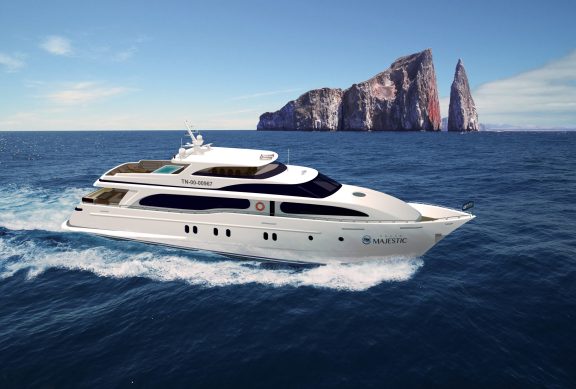
What the private route actually delivers
The park runs two distinct worlds, and each week’s itinerary covers one of them — not both. The western route takes you into the raw volcanic islands around Fernandina and Isabela. The eastern and northern route covers the greener, wildlife-dense sites at Española, Genovesa and Bartolomé. If your children only get one Galápagos trip and you want both worlds, you sail back-to-back weeks — one eastern, one western — on the same boat.
In the water, families get sea lions, turtles, rays and reef sharks on most snorkel stops, with seasonal hammerheads and whale sharks depending on the month. The warm season (December–May) brings calmer seas and warmer water — easier for young or nervous swimmers. The cool, choppier garúa season (June–November) rides the Humboldt current and brings the richest marine life and best visibility, but rougher crossings.
Travelling with young children who tire in swell? Lean toward December to May. Teens who dive and want the big pelagics? The June–November upwelling season is worth the cooler water and motion.
Best boats for a Galápagos family charter
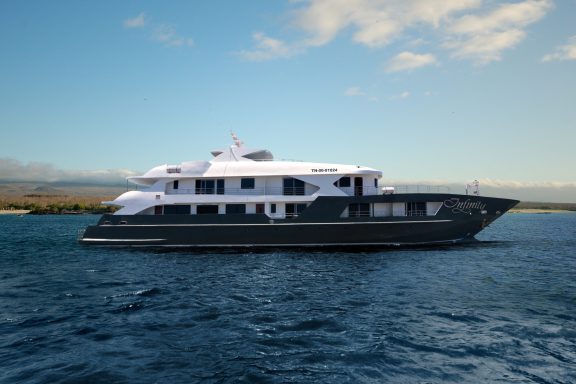
The Galápagos fleet is deliberately small — strict local rules keep it to expedition catamarans and mid-size motor yachts, with mega-ships banned and the largest expedition vessels capped at roughly 90 to 100 passengers. Weekly rates across our listed Galápagos fleet run from about $63,225 to $650,000 depending on vessel and season.
Expedition power catamarans, up to 14 guests, are the default family choice: steady at anchor, easy to move around with children, and sized to the 16-person park landing cap. Shorter charters such as Sea Star (5 days, from around $54,000) and Galaxy Sirius (6 days, around $125,000) show the spread. For families wanting more space or range, a mid-size motor yacht is the alternative. ELDAMAR is one such motor yacht that has repositioned into Galápagos and works well for a single family wanting room without sharing the boat.
Because vessels move in and out of the region seasonally, the exact list changes through the year — so we confirm which specific catamarans and motor yachts are actually in Galápagos for your dates before recommending one. Browse by fit: our power catamarans, the wider Galápagos charter collection, or filter by rate with yachts under $100k per week and large-group yachts for 12–20 guests.
 Leonidas Marousos, Charter Broker at DMA Yachting
FAQ
Can I design my own route around the Galápagos?
No. Every yacht follows a park-approved eastern or western itinerary on a fixed calendar, and the route cannot be changed once underway. What a private catamaran gives you is control over daily timing and pace within that approved route — not a free-roaming plan. To see both the western and eastern worlds, you sail two consecutive weeks, one route each.
What extra fees should a family budget beyond the charter?
Government fees are charged per person and change periodically, so confirm the current rates before you travel. As a guide, the national park entry fee for a non-resident adult is $200, with a reduced rate for children, plus an INGALA transit control card of around $20–$30 each. Then add domestic flights from mainland Ecuador, crew gratuity (typically 15–20% of the base rate), and, on plus-expenses charters, an APA (Advance Provisioning Allowance covering fuel, food and dockage). Standard APA is usually 25–35% of the base rate; Galápagos often sits at the upper end because fuel and park logistics are expensive here.
Is a catamaran or motor yacht more comfortable in Galápagos seas?
Catamarans are generally steadier at anchor and in moderate swell, which helps younger children. In the choppier June–November garúa season, a larger mid-size motor yacht with more range and mass can ride crossings between islands more comfortably.
How far ahead should we book a family Galápagos charter?
Book 8–12 months before you sail for peak windows like Christmas, New Year and June–August, when the best family cats fill first and prices run 20–45% above shoulder months. Boats also relocate between regions each season, so availability tightens quickly.
Which itinerary is best for a first family trip?
If you can only sail one week, choose the route that matches your family. The western route (Fernandina, Isabela) is the raw volcanic landscape and dramatic scenery. The eastern and northern route (Española, Genovesa, Bartolomé) is denser wildlife and easier snorkelling. If you want both and have the time, sail two back-to-back weeks — that is the fullest single introduction to the archipelago.
More yachts available in Galápagos
Motor yachts


Plan Your Galápagos Charter With Real Experts
Tell us how you like to travel and our charter team will hand-pick the right crewed yachts, dates and route — no obligation.
Our Top Galápagos Recommendations
We put these shortlists together because most travellers don’t need to weigh up every yacht on the water — just the handful that consistently get this kind of trip right. Each guide below digs into the boats, the best months to go, and the trade-offs worth knowing before you book.




















 iMessage
 WhatsApp




































