Quick answer
- Choose Norway if: you want the more accessible fjord charter, a wider fleet from 30m up, and easy anchoring in sheltered water most nights.
- Choose Chilean Patagonia if: you want genuine remoteness, glacier faces, and are willing to run a true expedition program on a capable yacht.
- Best Norway months: June to September for the fjords and midnight sun; May–June and September for lower rates and fewer crowds.
- Best Chile months: November to March (Austral summer) — but expect strong winds and sudden storms even in peak season.
- Cost differs: Norway crewed yachts start from around $50,000/week and rise well past $200,000 for expedition superyachts. Chile spans a wider range — smaller crewed yachts start far lower, while expedition-capable boats sit high because of the fuel and logistics load.
- Vessel matters more in Chile: the Chilean fjords demand a reinforced, stabilized expedition yacht — not a standard motor yacht.
For most first-time fjord charter guests, we recommend Norway. It is the easier, more forgiving charter, with a broad fleet, short logistics, and sheltered anchorages that let you wake up somewhere private most mornings. We steer guests toward Chilean Patagonia only when they specifically want a harder, wilder, expedition-led trip — glacier faces, near-empty water, and the willingness to plan around genuinely unpredictable weather.
Both are cold-water fjord destinations with dramatic scenery. But the charter reality is different in season, vessel, crew requirement, and pace. Get the wrong one and you either overpay for complexity you didn’t want, or under-spec a boat for water that punishes it.
 Susannah Deehan, Charter Broker & CYBA Member at DMA Yachting
Norway vs Chilean fjords: the head-to-head
| Option | Best for | Not ideal for | Typical cost |
|---|---|---|---|
| Norwegian fjords | First-time fjord guests, families, couples wanting scenery with comfort and short logistics | Guests chasing true remoteness or an untouched-frontier feel | From ~$50,000/week (crewed yachts 30m+) |
| Chilean Patagonia | Experienced expedition travelers, sea-and-mountains itineraries, guests who want empty water | Anyone wanting predictable weather, easy access, or a large fleet to choose from | Wide range — smaller crewed yachts start far lower; expedition-capable boats and superyachts run to $200,000+ |



Who Norway fits
Norway is our default recommendation for a first cold-water fjord charter. With a deeply indented coastline and thousands of fjords, you can anchor in sheltered water most nights without a hard passage between them. Geirangerfjord and Nærøyfjord — both UNESCO-protected — deliver the sheer glacier-cut walls most guests come for.
This suits families, couples, and mixed-ability groups who want dramatic landscape without an expedition mindset. The fleet is deep, the crew pool is experienced, and shore logistics are simple, with good flight connections into the region. Availability is healthier than in Patagonia, but the best boats still book up for the short summer window, so reserve early.
 Chris de Kock, Charter Broker, Sales Broker, Active CYBA Member at DMA Yachting
Who Chilean Patagonia fits
Chile is for guests who actively want the harder trip. The fjords run along a coastline stretching more than 4,000 miles, much of it empty. Between December and April you can kayak near migrating humpbacks and see penguin colonies from the water. Earlier expedition departures from September to November open heli-skiing for those who want it.
The land-based wildlife people picture — pumas and Andean condors — belongs to a Torres del Paine extension, not the deck of the yacht. Those are guided land experiences you add to the trip, and worth doing. The strongest Chile itineraries pair sea time with land: a few days in Torres del Paine gives you the mountains and the puma-tracking, then the yacht gives you the fjords and glacier faces. This is the destination for the traveler who has already done the comfortable charters and wants something with more edge.

Season and vessel
When to go — and what boat you actually need
The seasons sit in opposite halves of the year. Norway runs June to September for the fjords and midnight sun; May–June and September give superb weather with lower rates and fewer crowds. Chile runs November to March — the Austral summer, with long daylight. You will see average highs quoted around 15°C, but treat that number with care: Patagonia is defined by wind, not temperature. Sustained gusts and rapid change mean the wind chill on an exposed deck can feel far colder than the average suggests, and conditions can swing within a single day. Pack and plan for that, not for the number.
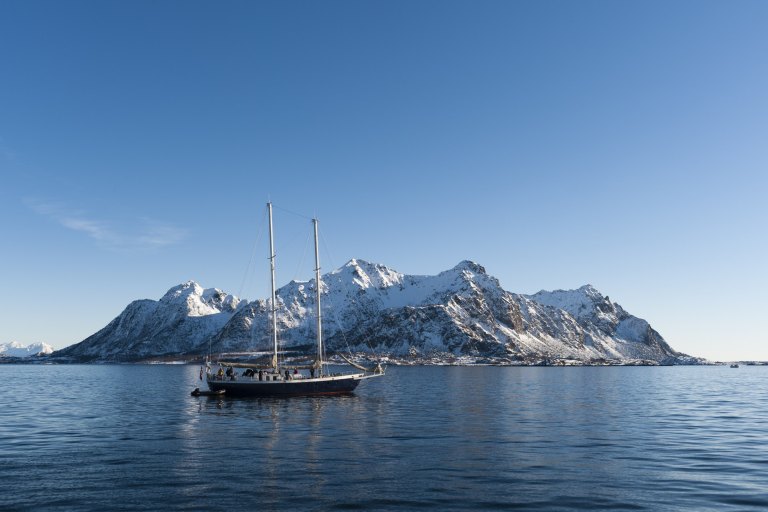
The vessel gap is bigger than most guests expect. Norway is well served by conventional crewed motor yachts and expedition yachts from 30m up. Chile’s fjords specifically demand expedition yachts built for rugged conditions — stabilizers, reinforced hulls, and off-grid capability — or a stable hybrid catamaran for the shallower inlets. This is the same logic that governs our polar programs: high-latitude, remote cruising needs a genuinely capable boat, which is why our Alaska expedition charters and Svalbard programs run on expedition-ready vessels, not repurposed leisure yachts.
 Jessica Edmunds, Charter Broker at DMA Yachting
Cost, chefs, and provisioning
Both are crewed-luxury destinations, but they don’t share a single price floor. Norway crewed yachts typically start from around $50,000 per week and rise past $200,000 for expedition superyachts. Chile spans a wider band: smaller crewed yachts start far lower, while expedition-capable boats and superyachts run high because of the fuel and logistics load. All figures here are indicative in US dollars and move with the boat, the season, and the year — treat them as ballpark, and ask us for a live quote against your dates. On top of the base rate, budget an APA (Advance Provisioning Allowance — the running fund for fuel, food, dockage, and taxes). That customarily runs 25–40%, sitting toward the lower end on sailing yachts and the higher end on motor yachts. Add crew gratuity, customarily 10–20%. In the Chilean channels the fuel share runs high because passages between safe anchorages are long, so the real all-in number sits at the upper end. Don’t compare a low-season quote against a high-season one for the same boat; it’s not a like-for-like number.
Provisioning differs on the plate. A chef in Norway works with cold-water fish and king crab; in Patagonia, with Pacific seafood and southern king crab from the channels. A strong onboard chef is consistently one of the best-value additions to a remote charter — there’s nowhere to dine ashore, so the galley is your restaurant. The honest tradeoff of a private crewed yacht over a cruise ship is flexibility: you set the anchorages, the pacing, and the day.
Our recommendation
For most guests, book Norway, aim for June to September, and take a crewed yacht from 30m up — you get the fjord scenery, comfortable anchoring, and short logistics without running an expedition. Choose Chilean Patagonia only if remoteness is the point: go November to March, put yourself on a reinforced expedition yacht with strong crew, and build in a Torres del Paine land extension for the pumas, condors, and mountains.
What we’d avoid: a standard motor yacht in the Chilean fjords, and a Patagonian itinerary locked to a rigid day-by-day plan. Both go wrong at sea. If you’re weighing warmer alternatives, our French Polynesia charters sit at the opposite end of the comfort scale. When you’re ready, tell us your dates and group size and we’ll match you to the right boat and season.
FAQ
Is Norway or Chilean Patagonia better for a first fjord charter?
Norway. The fleet is deeper, logistics are simpler, and sheltered anchorages let you cruise without hard passages. Chile is better as a second, more expedition-minded trip.
What months should I avoid in the Chilean fjords?
Outside November to March the daylight shortens and conditions get harder. Even within peak season (December to February), expect strong winds and sudden storms — the itinerary must stay flexible, and long exposed passages have to be timed to a weather window.
Do I need a special yacht for Patagonia?
Yes. The Chilean fjords need an expedition yacht with stabilizers, a reinforced hull, and off-grid capability, or a stable hybrid catamaran for shallow inlets. A standard motor yacht is the wrong tool here.
How much does a Norwegian fjord charter cost?
Crewed yachts start from around $50,000 per week, rising past $200,000 for expedition superyachts. On top of the base rate, add an APA (Advance Provisioning Allowance) that customarily runs 25–40% for fuel, food, and taxes, plus crew gratuity of 10–20%. Figures are indicative and move with the season — ask us for a live quote.
Can I see pumas and condors from the yacht in Patagonia?
Not from the deck. Pumas and Andean condors are land-based sightings, best seen on a guided Torres del Paine extension. From the water you get glaciers, humpbacks in season, and penguin colonies. We recommend combining both.
Can a chef source good local food in both destinations?
Yes, and it’s worth adding. Norway offers cold-water fish and king crab; Patagonia offers Pacific seafood and southern king crab. With no dining ashore in remote fjords, the galley is your restaurant.
More yachts available for this charter
Motor yachts
Catamarans
Expedition yachts
Plan Your Charter With Real Experts
Tell us how you like to travel and our charter team will hand-pick the right crewed yachts, dates and route — no obligation.
Our Top Recommendations
We put these shortlists together because most travellers don’t need to weigh up every yacht on the water — just the handful that consistently get this kind of trip right. Each guide below digs into the boats, the best months to go, and the trade-offs worth knowing before you book.




















 iMessage
 WhatsApp




































