Quick answer
- Best months: November to April, the northeast monsoon, for calm seas and 20–30m visibility.
- Peak conditions: December through March; December and January are the busiest and priciest.
- Watch out: January–February can turn unsettled, and some yachts leave the region during this stretch.
- Manta season: May to November brings aggregations to Hanifaru Bay in Baa Atoll, but rougher, greener water.
- Whale sharks: Ari Atoll year-round, with peaks February–April and August–November.
- Book early: 8 to 12 months before you sail for peak season; 5 to 7 months for manta season.
 Daniel Asmus, Owner, Charter Broker, Active CYBA Member, IYBA, ECPY at DMA Yachting
When to charter a yacht in the Maldives
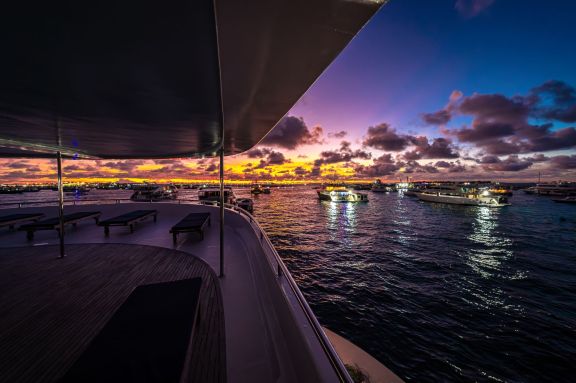
For most guests, charter the Maldives between November and April. That is the northeast monsoon: dry, stable, with the flattest seas and the best underwater visibility of the year. It is the window we steer first-time clients toward, and it sits inside our broader winter charter season alongside the Caribbean, the Bahamas and Indonesia.
The alternative is manta season, roughly May to November. It draws divers to Hanifaru Bay in Baa Atoll, but you trade calmer conditions for more swell and greener water. We only build a trip around it if the mantas are the whole point.



The dry window
November to April: the season for first-timers
Air temperatures sit around 82–88°F (28–31°C), water is 26–29°C, and visibility reaches 20 to 30 metres. Eastern atolls open up, crossings between atolls are comfortable, and tender and dive operations run cleanly. This is the classic liveaboard-style routing the Maldives does better than fixed resorts.
One caution: January and February can bring an unsettled patch, and a few charter yachts reposition out of the region during it. If those weeks are your only window, we book early and confirm the specific boat is staying put.
 Martina Asmus, Owner, Charter Broker, Active CYBA Member, IYBA, ECPY at DMA Yachting
May to November: manta and whale shark season
The southwest monsoon brings the plankton that pulls manta rays into Hanifaru Bay in Baa Atoll, a UNESCO Biosphere Reserve with a strictly regulated 80-person capacity in the water at any time. Whale sharks are in Ari Atoll year-round, with peaks February–April and August–November. For a dive-led group, this is the season with the biggest animals.
The tradeoff is real. Seas are choppier, visibility drops, and some anchorages that are easy in February become uncomfortable. We would not send a mixed family expecting calm sandbank days into peak wet season — but for divers chasing mantas, it is the right call. A yacht with proper scuba support onboard matters far more here than in the dry months.
Which season suits you
| Season | Best for | Not ideal for | Note |
|---|---|---|---|
| Nov–Apr (dry) | First-timers, families, calm sandbank days, best visibility | Anyone hoping to dodge crowds or peak pricing | Jan–Feb can be unsettled |
| May–Nov (wet) | Divers chasing mantas and whale sharks, quieter atolls | Guests wanting flat water and clear visibility | Book Baa Atoll 5–7 months before you sail |
The core of a Maldives charter is routing across 26 atolls — sandbanks, uninhabited islands, well-known dive sites, and big game fishing between them. We recommend 7 to 14 nights: 7 for a focused program around one atoll, up to 14 for a dive-heavy run reaching the southern atolls.
 Carina Isenberg, Charter Broker at DMA Yachting
The boat, the crew and the cost
The Maldives fleet is small — around a dozen charter yachts — and it is motor-yacht and superyacht dominated. Purpose-built liveaboards in the 30–60m range with multiple tenders and dive support are the realistic, best-fit vessels. Sailing catamarans are genuinely scarce here; clients who arrive set on a catamaran often have to be redirected to a motor yacht, and that is not a downgrade in these waters.
Rates run wide. Entry-level crewed yachts start near $35,000 per week; mid-tier motor yachts sit roughly $42,000–$66,500; and the largest motor yachts in the region start from $270,000 per week before expenses. On top of the base fee, budget 17% TGST, an APA of 35–40% for fuel, provisioning and permits, $12 per guest per night green tax, and a customary 10–20% crew gratuity.
If you want the same warm-water cruising with more sailing options and a larger, more varied big-boat fleet, weigh the Maldives against Thailand. For a broader sense of where these boats go, see our best charter locations.
FAQ
What is the single best month for a Maldives yacht charter?
March. You get the settled tail of the dry season, strong visibility and whale sharks in Ari Atoll during their February–April peak, without the January–February unsettled patch or the Christmas price peak.
Can I charter a sailing catamaran in the Maldives?
Rarely. The fleet is dominated by motor yachts and superyachts, and sailing catamarans are hard to source. Most clients are better served by a purpose-built motor liveaboard, which handles the atoll routing and dive support well.
How far in advance should I book?
Book 8 to 12 months before you sail for the November–April peak, and reserve early for Christmas and New Year specifically. For manta season in Baa Atoll, 5 to 7 months before you sail gives you the best choice of boats.
How long should a Maldives charter be?
Seven nights for a focused program around one atoll, up to 14 for a dive-heavy itinerary reaching the southern atolls. Seven days is the typical minimum charter duration here.
Is the wet season worth it?
For divers, yes — the manta aggregations at Hanifaru Bay and whale sharks in Ari Atoll are the payoff. For families wanting calm water and clear visibility, no. Choose the dry season instead.
Plan Your Maldives Charter With Real Experts
Tell us how you like to travel and our charter team will hand-pick the right crewed yachts, dates and route — no obligation.
Our Top Maldives Recommendations
We put these shortlists together because most travellers don’t need to weigh up every yacht on the water — just the handful that consistently get this kind of trip right. Each guide below digs into the boats, the best months to go, and the trade-offs worth knowing before you book.



















 iMessage
 WhatsApp




































