Quick answer
- For most first-time guests: 8 days (7 nights) is enough. One park-assigned loop — Eastern or Western — covers it well.
- For serious wildlife and diving guests: go 15 days (14 nights), run back-to-back loops, and you cover the whole archipelago.
- Why 14 days exists: since 2012 the park bars any vessel from repeating a visitor site within 14 days, so the full route is built as two distinct 8-day halves.
- The western islands catch: Isabela and Fernandina — penguins, flightless cormorants, the richest cold-water life — sit on the Western loop, which a single Eastern week never touches.
- The cost reality: Galápagos charters run roughly $63,000 to $650,000 per week. A second week roughly doubles the bill — base rate, second cruising permit, APA and crew.
- What you cannot do: design your own route. All itineraries are park-controlled and a naturalist guide is mandatory aboard.
For most first-time guests, we recommend the 8-day/7-night charter — one park-assigned loop, covered properly, with no fatigue. We only recommend the full 15-day/14-night voyage when the trip is built around wildlife or diving, and the guests genuinely want Isabela, Fernandina and the western volcanic islands as well as the eastern and central ones. The honest version of the tradeoff: a week leaves most people wanting more, but two weeks roughly doubles the cost for a return that matters to a specific kind of guest and is wasted on everyone else.
 Louis Lamprell, Charter Broker, Active CYBA Member at DMA Yachting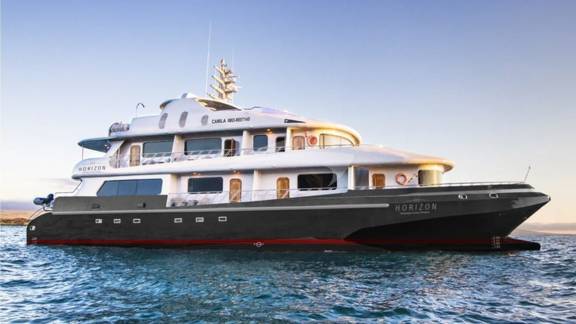
Start here
There is no real 7-day Galápagos charter — the unit is 8 days
The first thing to clear up: when brokers and operators say “7 days” in the Galápagos, they almost always mean a 7-night/8-day cruise — eight calendar days, typically Saturday to Saturday. A handful are sold as 6-day cruises with a land night added. There is functionally no pure 7-day product here, so the real comparison is 8 days versus 15 days, not 7 versus 14.
That 8-day unit exists for a reason. In 2012 the Galápagos National Park ruled that no permitted vessel may return to the same visitor site within 14 days, to spread foot traffic and reduce impact. Every yacht now runs on a 15-day/14-night master itinerary that owners slice into shorter segments — usually two equal 8-day halves.
So the two halves are not a long and a short option. They are two complete, separate routes that share a vessel. Book one half and you see roughly half the sites. Book both back-to-back and you complete the loop, visiting all-new landings and snorkel sites in the second week. This is the structure that governs your whole decision — more than budget, more than season, more than which boat. If you want the full picture of how routes are set, our Galápagos charter guides walk through the assigned loops in detail.


What an 8-day Galápagos charter actually covers
An 8-day charter buys you one park-assigned loop done thoroughly — either the Eastern/Central route or the Western route, not both. The most complete single-week product is the 8-Day Full Loop, which covers over 300 nautical miles across both western volcanic and eastern lush islands, beginning and ending at San Cristóbal. That is the version we steer most first-timers toward, because it touches both island characters in one week.
A typical eastern-weighted week gives you Española for the waved albatross and blue-footed boobies, Genovesa for the seabird colonies and red-footed boobies, Bartolomé for the iconic landscape and penguins near Pinnacle Rock, and Santa Cruz for the giant tortoises and the Charles Darwin Research Station. It is a strong, varied week. Nobody leaves disappointed.
Where a single week falls short is depth on any one region and, critically, the far western islands. Most eastern loops never reach Isabela’s western coast or Fernandina at all — and that is exactly where the rarest concentrations sit. A week is the right length for guests who want a genuinely excellent expedition without rearranging two weeks of their lives. It is not the right length if your reason for coming is the western wildlife.
 Susannah Deehan, Charter Broker & CYBA Member at DMA Yachting
What the western islands add — and why a 14-day voyage exists
The western loop is the reason serious wildlife guests extend. Isabela and Fernandina are the youngest, most volcanically active islands, washed by the cold, nutrient-rich Cromwell upwelling. That cold water concentrates marine life you simply do not see in the same density on the eastern routes.
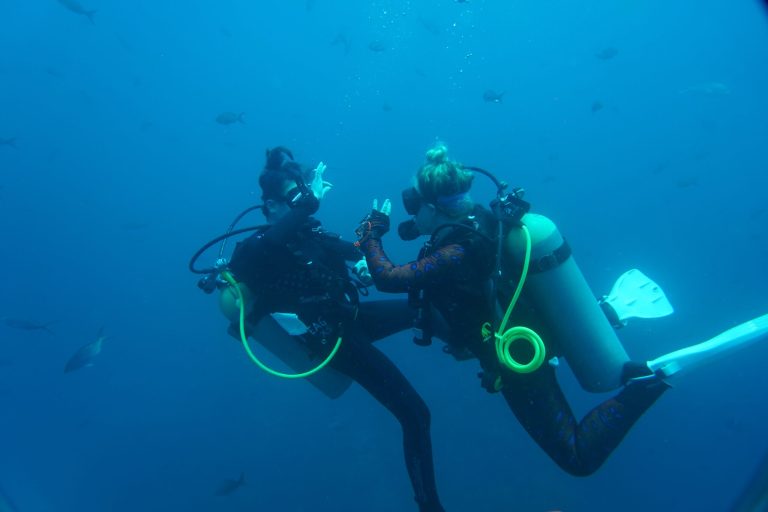
This is where Galápagos penguins, flightless cormorants, and the largest marine iguana populations live. Snorkelling off Fernandina and western Isabela puts you with penguins, sea lions and, in the cool season, an abundance the eastern sites can’t match. For divers, the cool/dry months (June to November) bring whale sharks and hammerheads to the remote Darwin and Wolf area in the far north — a different proposition again, and one only certain dive-permitted vessels run.
Combine both loops and you cover the entire archipelago in 15 days, with the second week landing entirely new sites. Operators like Quasar split the two weeks into equal 8-day halves of matched quality — same calibre of landings, encounters and activities — so you are not trading down for the second week. That is the definitive Galápagos experience, and it is the one returning visitors and committed naturalists keep choosing. If diving drives your trip, look specifically at yachts with scuba diving onboard, as not every Galápagos vessel is permitted or equipped for it.
8 days vs 15 days: the comparison that matters
| Option | Best for | Not ideal for | Typical cost |
|---|---|---|---|
| 8 days / 7 nights (one loop) | First-timers, families, couples wanting one excellent expedition | Guests whose main goal is western/cold-water wildlife or diving at Darwin & Wolf | ~$63,000–$650,000 for the week, whole boat |
| 15 days / 14 nights (both loops) | Returning visitors, serious wildlife and dive enthusiasts, full-archipelago guests | Tight schedules, mixed-interest groups, anyone watching cost-per-day hard | Roughly double — second base rate, second permit, more APA |
The dimensions where the choice flips are not about the boat. They are about wildlife goals, time and money. If Isabela, Fernandina and the cold-water species are the reason you’re coming, one eastern week will leave the trip’s whole point unfulfilled — and that is a far worse outcome than spending more.
If you have a mixed group — some keen birders, some who just want a beautiful expedition and a comfortable boat — a single week usually keeps everyone happy without anyone tiring of daily landings. Two weeks of twice-daily excursions is a lot for guests who aren’t there for the wildlife specifically.
 C.J. Coetzee, Charter Broker at DMA Yachting
What a second week actually costs
Galápagos charter rates are high by design — a deliberately capped fleet, strict permits and limited availability mean scarcity pricing. The whole-boat rates we list run from around $63,225 to $650,000 per week. For real-world reference: Seaman Journey, a 16-guest catamaran, lists near $83,540 for a 7-day charter; the Infinity motor yacht runs about $160,450 for 8 days for up to 16 guests.
A second week roughly doubles the base rate. But the extras stack on top. Motor yachts carry an APA (advance provisioning allowance, covering fuel, food and consumables) of around 30–35% of the base fee; sailing yachts and catamarans run 20–25%. Crew gratuity is typically 15–20% of the base. As a rule of thumb, budget base rate × 1.5 for a realistic all-in number before flights.
On top sit the per-person fixed costs: $100 park entry per adult ($50 per child under 12), a roughly $20 transit control card, and $350–$500 round-trip flights from mainland Ecuador. These don’t double — you pay park entry and flights once — which is one of the few places the second week is relatively efficient. To frame your budget early, our yachts under $100k and luxury yacht pages give a sense of where boats sit.
Why “longer means more flexibility” does not apply here
In most destinations, a longer charter buys you freedom — more anchorages, more spontaneity, the option to linger somewhere you love. The Galápagos breaks that logic. Every yacht, including a fully crewed private charter, follows a pre-approved park itinerary that cannot be changed once underway. A naturalist guide must be aboard, landings are timed and zoned, and free-roaming private routes are not permitted.
So a second week does not give you more flexibility. It gives you the other loop. That is a meaningful distinction. You are not extending to relax the schedule — you are extending to see different islands under the same fixed rules. Bareboat charter doesn’t exist here at all, for the same reasons.
This is also why crew quality matters more the longer you stay. In our experience across destinations, crew is the single biggest factor in whether a charter lands well — more than the yacht’s condition. On a tightly scheduled, guide-led 14-night expedition with twice-daily landings, a sharp, warm crew and a strong naturalist make the difference between a long trip and a great one. If you want to understand how the fleet here compares to freer-roaming regions, the contrast with French Polynesia or Raja Ampat charters is instructive.
Which boats fit each plan
The Galápagos fleet is small and specialised — mostly expedition power catamarans and motor yachts in the 27–45m range, carrying up to about 16 guests, plus the occasional small expedition ship for full-ship charters. You are not choosing between dozens of boats; you are choosing among the yachts that suit your group size, budget and whether you want diving aboard.
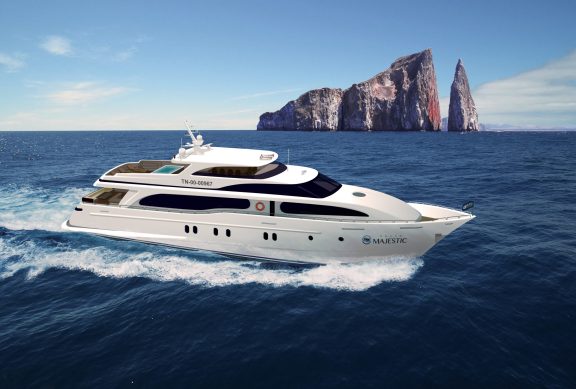
For a one-week loop with a family or a couple of families, a stable, well-crewed motor yacht is the comfortable default. GALAPAGOS HORIZON — 8 cabins, 38.1m, from $63,225 per week — sits at the more accessible end and works well for a single excellent week. Grand Majestic, 8 cabins at 38.7m, is another solid motor-yacht option in a similar bracket.
For a full 15-day, two-loop voyage — especially a wildlife- or dive-led one — you want a boat you’ll happily live aboard for two weeks, with the right range, stabilisation and ideally diving onboard. ELITE, a 9-cabin, 37.5m motor yacht, is the kind of vessel built to carry a discerning group comfortably across both loops. Across the fleet, comfort at sea matters more on the choppier cool-season western routes than first-timers expect, so the boat is not a detail here — it’s part of the decision. Browse the wider field of power catamarans if a multihull’s stability and deck space appeal.
Our recommendation
For most guests — first-timers, families, couples, mixed-interest groups — book the 8-day/7-night charter and ask for the 8-Day Full Loop where the calendar allows. It covers both island characters, runs at a sane pace, and leaves on a high rather than a plateau.
Choose the full 15-day/14-night voyage only when the trip is genuinely built around wildlife or diving and the guests want Isabela, Fernandina and the western cold-water life as well as the eastern islands. For those guests it is the definitive version, and a single eastern week would miss the whole point.
What we would avoid: booking a single eastern-only week and assuming you’ve “done” the Galápagos when penguins, flightless cormorants and the western volcanic islands are why you came. And booking 14 nights for a mixed group with no special wildlife agenda — that’s a long, tightly scheduled trip and a doubled bill for a return only some of you will value. Tell us your guests, your season and your wildlife priorities, and we’ll match the right loop, length and boat. Peak windows (mid-June to September, mid-December to mid-January) push prices up 20–30% and want booking 8–12 months ahead, so the earlier we start, the better the placement.
FAQ
Is one week enough for the Galápagos?
For most first-time visitors, yes. An 8-day/7-night charter on one park-assigned loop — ideally the 8-Day Full Loop out of San Cristóbal — covers a strong range of islands and wildlife well. It only falls short if your specific goal is the western islands (Isabela, Fernandina) or diving at Darwin and Wolf, which a single eastern week doesn’t reach.
Why is the full Galápagos itinerary 14 nights and not just longer at will?
Since 2012, the National Park bars any vessel from returning to the same visitor site within 14 days. So the full route is built as a 15-day/14-night cycle split into two distinct 8-day halves. To see the entire archipelago you run both halves back-to-back, landing all-new sites in the second week.
Can I design my own route on a private Galápagos charter?
No. Even a fully crewed private charter must follow a pre-approved, park-controlled itinerary with a licensed naturalist guide aboard, and that route cannot be changed once underway. Free-roaming private routes and bareboat charters are not permitted in the national park.
How much more does a 14-night Galápagos charter cost than a week?
Roughly double the base rate, plus a second cruising permit and more APA and crew. Whole-boat rates run from about $63,225 to $650,000 per week. Budget base rate × 1.5 for a realistic all-in figure. Per-person park entry ($100 adult), the transit card (~$20) and flights ($350–$500 round trip) are paid once, not twice.
Which season suits the longer Galápagos voyage?
For western and cold-water wildlife — penguins, whale sharks, hammerheads, abundant marine life — the cool/dry season (June to November) is strongest, with water at 65–75°F but choppier seas. For calmer water (77–81°F) and the best snorkelling visibility, the warm/wet season (December to May) wins. A 14-night voyage built around diving leans cool/dry.
More yachts available in Galápagos
Motor yachts


Plan Your Galápagos Charter With Real Experts
Tell us how you like to travel and our charter team will hand-pick the right crewed yachts, dates and route — no obligation.
Our Top Galápagos Recommendations
We put these shortlists together because most travellers don’t need to weigh up every yacht on the water — just the handful that consistently get this kind of trip right. Each guide below digs into the boats, the best months to go, and the trade-offs worth knowing before you book.





















 iMessage
 WhatsApp




































