Quick answer
- Real range: Antarctica crewed charters start near US$245,000/week for smaller polar vessels like Hanse Explorer and climb past US$2,000,000/week for the largest explorers.
- Add 50–60% on top: APA and gratuity stack well above the Med or Caribbean norm, and a fly-in adds more again.
- You need a polar-ready ship: the Peninsula requires an ice-capable expedition hull, not a standard charter yacht.
- The flight alone: a fly-in from Punta Arenas to King George Island runs about US$125,000 each way.
- Narrow season: November to late March only, with mid-December to mid-February the priciest weeks.
- Depart Ushuaia: most trips run 8–12 days from southern Argentina, crossing the Drake Passage.
 Chris de Kock, Charter Broker, Sales Broker, Active CYBA Member at DMA Yachting
Antarctica expedition yacht charter cost: why it runs higher
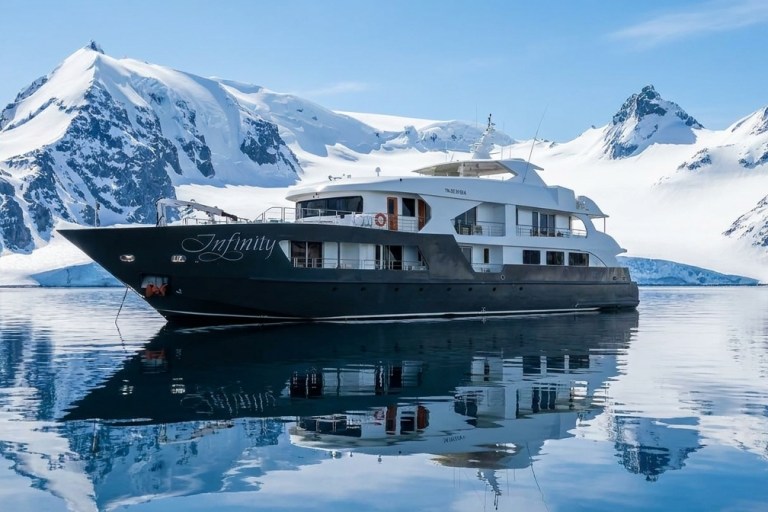
An Antarctica crewed expedition charter costs more than a Mediterranean or Caribbean one because almost every cost driver is stacked against you at once: a specialized ice-capable ship, a narrow season, remote positioning out of Ushuaia, mandatory experienced expedition crew, and permits that don’t exist anywhere else. This is the right trip for guests who want a private vessel, a flexible route, and ice, penguins, and whales on their own schedule — not for anyone chasing a value week at sea.
The headline number tells most of the story. Smaller polar expedition vessels run from roughly US$245,000/week, mid-fleet explorers sit around US$550,000–US$800,000/week, and the largest run past US$2,000,000/week. To keep this piece easy to compare, we quote every figure in US dollars — most Antarctic charters are contracted in USD, though a European-flagged vessel may bill in euros, in which case the exchange rate on your contract date sets the final number.
Catamarans



The biggest lever
The ship is the main cost driver
The Antarctic Peninsula requires a polar-ready, ice-capable hull built for range and self-sufficiency — a different class of vessel entirely from the fleet you’d charter in the Maldives or the Med. These ships carry more fuel, more redundancy, and more capable crew, and that shows up in the weekly rate.
The spread runs from purpose-built polar expedition ships at the lower end to full superyacht explorers at the top. The larger the explorer, the higher the fuel burn, and the deeper the crew roster — which is why the weekly rate can more than triple across the Antarctic-capable fleet. We match you to the right vessel for your dates and party size rather than the biggest one available; availability south is limited, so tell us your window early and we’ll reserve the boats that fit before they go.
 Marcelle Hailwax, Charter Broker at DMA Yachting
Permits, ice pilots, and the season window
Every Antarctica-bound yacht must be authorized by its flag state, and strict penalties apply to any vessel going south of 60°S without a permit. Under the guidelines of the International Association of Antarctica Tour Operators (IAATO), expedition teams are expected to carry a high proportion of members with prior polar and Antarctic experience — you are paying for a crew that has done this before, not a standard deck-and-galley team.
Fuel rules add cost too: inside the Antarctic Treaty Area, ships must burn lighter, cleaner-grade fuels under International Maritime Organization (IMO) rules. Combine that with a season that runs only November to the end of March, and you have a small number of qualified ships chasing a five-month window. Scarcity is real, and it prices in.
Catamarans


Expedition yacht charter Antarctica: what to expect on top of the base fee
Antarctica charters are quoted “plus expenses,” so the weekly rate is only the starting point. Here is what to expect stacked on top, and roughly what each adds.
The Advance Provisioning Allowance (APA) is a cash float, paid ahead of the trip, that covers fuel, port and pilotage fees, food, and consumables. On most charters APA is set at 30% of the base fee. For fuel-hungry polar vessels running long distances, it can be set higher — 35% is a fair planning figure for Antarctica, and the largest explorers can go beyond that. On top of APA, crew gratuity is customary and calculated on the base fee, typically 10–20% depending on the vessel and how the trip goes.
Put those two together and you land at roughly 40–55% on top of the base fee before any flights — call it 50% as a working number. Add an optional Punta Arenas fly-in and the total climbs further again.
| Line item | Typical figure | What it covers |
|---|---|---|
| Base charter fee | US$245k–US$2m+/week | The vessel and its permanent crew for the week |
| APA | ~30–35% of base | Fuel, port and pilotage fees, food, consumables |
| Crew gratuity | 10–20% of base | Discretionary tip to the crew, paid at trip end |
| Fly-in (optional) | ~US$125k each way | Private aircraft from Punta Arenas to King George Island |
Here is the full math once, cleanly, on a US$750,000/week charter:
- Base fee: US$750,000
- APA at 35%: +US$262,500
- Crew gratuity at 15% of base: +US$112,500
- All-in total: US$1,125,000 — a 50% uplift on the base fee, before any fly-in.
That is the sticker-shock math to plan around. Add a shared fly-in and you can push another six figures onto the total.
Then there is access itself. A private aircraft from Punta Arenas to King George Island runs about US$125,000 each way, sometimes roughly halved if the plane is shared with another charter. Most trips instead depart Ushuaia and cross the Drake Passage — around 2.5 days each way — which is the more common and less eye-watering option.
 Martina Asmus, Owner, Charter Broker, Active CYBA Member, IYBA, ECPY at DMA Yachting
Is a private charter worth it over an expedition cruise?
For most first-time Antarctic travelers, a luxury expedition cruise ship delivers most of what draws people south — the ice, the wildlife, the landings — with a fraction of the bureaucracy and cost, at a per-person berth rate rather than a full-vessel charter fee. We only build a private charter when privacy, a dedicated crew, and route flexibility genuinely matter to you.
What the premium buys is control: your own vessel, your own zodiac cruising to glacier faces and ice floes, and the freedom to linger where the wildlife is instead of following a fixed cruise itinerary. If that flexibility isn’t the point of the trip for you, we’d steer you to a cruise and put the budget toward a private charter somewhere like the Galápagos, Alaska, or French Polynesia instead. For a wider view of where a private charter earns its cost, our charter insights and best locations pages are the right next read.
FAQ
How much does an Antarctica private yacht charter cost per week?
Base rates start near US$245,000/week for smaller polar vessels like Hanse Explorer, sit around US$550,000–US$800,000/week for mid-fleet explorers, and exceed US$2,000,000/week for the largest ships. Expect APA and gratuity to add roughly 50% on top of the base before any flights.
When is the cheapest time to charter Antarctica?
Early November and late March are the shoulder weeks and can cut costs by up to 20% versus peak. Mid-December through mid-February, especially the Christmas and New Year departures, are the most expensive.
Why can’t I use a standard charter yacht in Antarctica?
The Peninsula requires a polar-ready, ice-capable hull with the range and self-sufficiency to operate in remote waters, plus a crew meeting IAATO experience expectations. A standard Med or Caribbean yacht is neither built nor permitted for it.
Do I have to cross the Drake Passage?
Most charters depart Ushuaia and cross the Drake, roughly 2.5 days each way. You can fly instead from Punta Arenas to King George Island, but the private aircraft costs about US$125,000 each way, sometimes roughly halved if shared with another charter.
How long is a typical Antarctica charter?
Most run 8 to 12 days, with 10–11 day trips covering around 600 nautical miles. The season itself runs November to the end of March.
More yachts available for this charter
Motor yachts


Catamarans


Plan Your Charter With Real Experts
Tell us how you like to travel and our charter team will hand-pick the right crewed yachts, dates and route — no obligation.
Our Top Recommendations
We put these shortlists together because most travellers don’t need to weigh up every yacht on the water — just the handful that consistently get this kind of trip right. Each guide below digs into the boats, the best months to go, and the trade-offs worth knowing before you book.



















 iMessage
 WhatsApp




































