Quick answer
- Best value for groups of 8+ staying 10 nights or more: this is where the per-guest cost of a crewed yacht narrows fastest against a resort stay. The yacht is still usually the bigger total, but by a much smaller multiple, and it buys a multi-atoll route no single resort island can offer.
- Best for a couple, a small group, or a short stay: a resort in North or South Malé Atoll is close to always the cheaper choice. A charter under seven nights, or under four guests, rarely earns back the fixed cost of a captain, chef, and crew.
- Fleet reality: the Maldives charter fleet is dominated by 30 to 60m motor yachts and superyachts; sailing catamarans are scarce and hard to source here.
- Manta season: May to October brings the aggregations at Hanifaru Bay in Baa Atoll, reachable by boat, not by a typical resort excursion. See our full guide to the best months to charter the Maldives.
- Calmest window: November to April is the dry season, with steadier crossings and the best visibility for diving Maaya Thila and the outer atolls.
- Minimum trip length: 10 nights is the practical minimum for a multi-atoll route; 14 nights is the sweet spot for a dive-heavy itinerary through Vaavu, Meemu, Thaa, and Laamu.
For groups of eight or more staying 10 nights or longer, we usually recommend the crewed yacht charter over a single resort stay. The yacht is almost always the larger total figure, but the gap per person narrows sharply once you add up transfers, excursion-reef access, and dive trips across a full group, and the yacht delivers a multi-atoll route no single resort island can offer. For a couple, a small group, or a three- to five-night trip, a resort in North or South Malé Atoll is still the simpler and cheaper option, usually by a wide margin. The fixed costs of a crewed charter, meaning the captain, chef, engineer, fuel, and provisioning allowance, do not spread well across a small party or a short stay.
This piece focuses on where the value actually lands for different group sizes and trip lengths. For a line-by-line fee audit, meaning GST, provisioning allowance, and every transfer cost, see our companion piece, what a private yacht vs. Maldives resort actually costs. We keep exact figures out of this piece deliberately: villa rates, charter fees, and taxes move by season and by boat, and a number that’s accurate today is often stale by the time you book. Ask us for current availability and a real quote before you budget off anything you read online.


What’s in the rate
What a crewed Maldives yacht charter actually includes
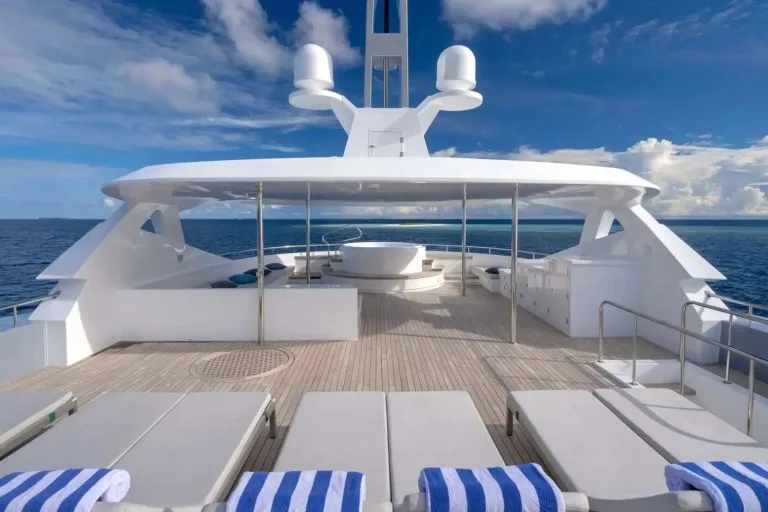
The charter fee covers a captain, a chef, and a crew who run the boat, cook every meal to order, and reset the itinerary daily around weather and guest requests. It also covers fuel for atoll-to-atoll running, tenders for reef and sandbank access, snorkeling gear, and, on the boats set up for it, dive support and compressor fills.
That combination, crew, meals, fuel, tenders, and gear, all bundled into one fee, is what makes a Maldives luxury yacht charter effectively all-inclusive, in a way a resort rate never quite is. Dining is not fixed to one restaurant schedule. A private chef means breakfast on the sundeck, lunch on a sandbank in Ari Atoll, and dinner back on board, with no reservation needed and no menu upcharge for the fresh catch. A resort villa rate covers the room. Almost everything else, from the boat that gets you to a dive site to the reef you’re allowed to snorkel for free, is priced separately.
The hidden math
What accumulates on a resort bill that isn’t in the headline rate
The nightly resort rate is a per-villa number, not a per-guest number, and it rarely includes the things that make a Maldives trip worth flying to. Seaplane or speedboat transfers are charged per person, each way. The house reef in front of your villa is usually free to snorkel; the better reef, the manta cleaning station, or the whale shark site is a paid excursion, often with a per-person boat fee.
Diving is billed per dive or in packages. Sandbank picnics, sunset cruises, and motorized water sports are add-ons. Multiply any of that across a family of six for a week and the “cheap” nightly rate stops looking cheap. On a yacht, the equivalent activities, the sandbank stop, the reef, the tender ride, are already part of the day, not a line item.
| Option | Best for | Not ideal for | Typical cost structure |
|---|---|---|---|
| Crewed yacht charter | Groups of 8+, multi-atoll routes, dive-focused trips of 10+ nights | Couples, first-timers wanting a fixed daily rhythm, trips under a week | Charter fee + GST + advance provisioning allowance, split across the whole group |
| Resort stay | Couples, short 3-5 night trips, guests who want a set base with no logistics | Large groups wanting to see more than one atoll or reach southern dive sites | Nightly villa rate, per room, plus separate charges for transfers, excursions, and dives |
Cost structure
How the per-person cost gap narrows with group size and trip length
Rather than quote a single “average” rate for either option, which would be out of date within a season, it’s more useful to understand why the two are structured so differently. A villa rate is quoted per room, per night. A charter fee is quoted per week, per yacht, regardless of how many of the cabins are filled. That mismatch is what makes the comparison hard to do on headline numbers alone, and it’s also what drives the value shift as your guest count and trip length change.
A couple on a short trip is where the gap is widest. A resort villa rate already splits across two guests, and the extra costs, transfers, one or two excursions, add relatively little on top of that. A charter, by contrast, has to cover the minimum booking length most yachts hold to, commonly around seven nights, and the full weekly charter fee, crew, and provisioning allowance now split across only two people. That fixed cost does not shrink because fewer guests are aboard. This is exactly why we would not normally build a two-guest trip around a charter.
A larger group over a longer stay is where the gap narrows fastest. A resort’s per-villa rate now needs multiplying by several rooms, and every transfer, excursion, and dive is billed per person, per day, across the whole party. A charter’s fee stays fixed per week no matter how many cabins are occupied, so filling five cabins instead of one spreads that same fixed cost over far more guests. The yacht is still typically the larger total once GST and the provisioning allowance are added on top of the charter fee, but the per-person gap against the resort narrows sharply once you reach eight to ten guests over ten nights or more.
That is the shift that matters: the gap does not flip, but at a certain size and length the question stops being “which is cheaper” and becomes “is the extra per head worth a private route through Vaavu, Meemu, and Baa Atoll that the resort’s day boats cannot run.” For the right group, it is. For a couple on a five-night trip, it almost never is. Send us your guest count, dates, and how many of you dive, and we’ll run the real, current numbers for your trip rather than a generic figure.
Group economics
Who the numbers favor: groups of eight or more
The group profile where this works hardest is eight to ten guests split across four or five ensuite cabins, staying ten nights or longer, with at least half the party diving. That is the itinerary where the extra fee buys the most, because a resort simply cannot get you to a site like Fotteyo Kandu in Vaavu Atoll, or the channel dives further south in Thaa and Laamu, without running its own private boat transfer, at its own separate cost, for every guest, every day.
A resort, by contrast, multiplies every add-on by the number of guests and the number of days. A yacht also reaches places a resort simply cannot. Baa Atoll is a UNESCO Biosphere Reserve, and from May to October it hosts manta aggregations at Hanifaru Bay that no resort day-trip boat covers well. Further south, Vaavu, Meemu, Thaa, and Laamu Atolls sit outside the resort-dense central atolls entirely, with quieter dive sites and fewer boats in the water. This is the ten-night, multi-atoll route we build most often for groups of this size.
When the resort wins
Who should still book a resort instead
We would not normally recommend a charter for a couple, a solo traveler, or a trip under a week. The fixed crew and provisioning costs of a yacht don’t amortize well over two guests, and a resort villa in North or South Malé Atoll gives you snorkeling, sandbanks, and easy arrival logistics without the minimum trip length a charter needs to make sense.
A resort is also the right call for a first Maldives trip with no dive agenda. If you want one base, a predictable daily rhythm, and no interest in reaching the outer atolls, book the resort. Some guests split the difference: three or four nights at a resort near Malé, then a shorter yacht leg for the atolls a resort can’t reach. That combination works better than forcing a full week on a boat for two people.
Boat, not brochure
The Maldives fleet reality: motor yacht, not catamaran
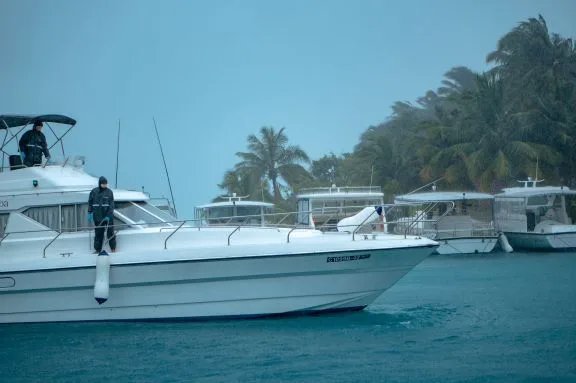
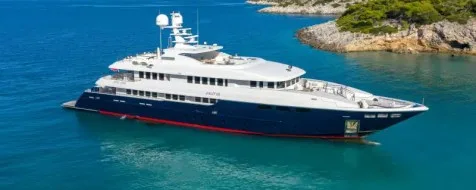
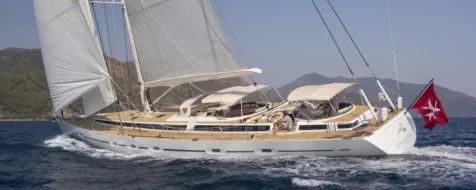
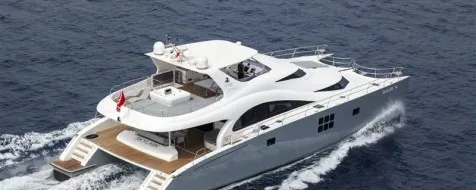
The Maldives charter fleet is small, roughly a dozen vessels, and it is motor-yacht and superyacht dominated. Purpose-built 30 to 60m boats with multiple tenders and dive support are the standard here, not sailing catamarans. Clients who ask specifically for a catamaran in the Maldives usually get redirected to a motor yacht once we check what’s actually available; sailing cats are scarce in this market and hard to source on short notice.
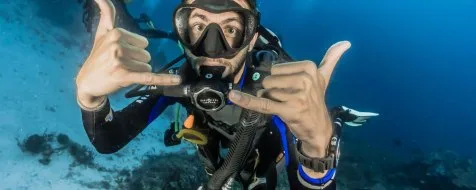
Within that motor-yacht fleet there is a distinct dive-led option, built around compressor capacity, dive tenders, and a route planned around dive sites like Maaya Thila and Fotteyo Kandu rather than sandbanks and sunset cruises. If diving is the priority, ask for that boat type specifically rather than assuming any Maldives yacht covers it well. This is where guests get caught out most often: they book a general-purpose motor yacht expecting a serious dive itinerary, and the compressor capacity or the guide-to-diver ratio isn’t there when they arrive. Our guide to choosing the right yacht for the Maldives atolls covers how to tell the two boat types apart before you book.
Is a Maldives yacht charter more expensive than a resort?
Per villa per night, a resort usually looks cheaper on paper, and it usually is. Per guest, once transfers, excursion-reef access, and dive trips are added up across a group of eight or more over ten nights or longer, the gap narrows sharply. The charter is still typically the bigger total; what changes is how much extra you’re paying for a multi-atoll route, and that extra shrinks fast as the group grows and the trip lengthens.
Is a Maldives yacht charter worth it?
For a group of eight or more staying ten nights or longer, with real diving on the agenda, yes. You’re paying more per person than a resort, but that extra buys a route through Baa, Vaavu, Meemu, and further south that no single resort island can reach, plus meals, tenders, and reef access that would otherwise be billed separately every day. For a couple or a short stay, a resort is worth it and a charter usually is not.
What’s included in a crewed Maldives yacht charter, and is it all-inclusive?
The charter fee covers the captain, chef, and crew, fuel between atolls, tenders, snorkeling gear, and, on dive-focused boats, dive support. Meals are cooked to order rather than served on a fixed restaurant schedule. In that sense it functions like an all-inclusive package once the charter fee, GST, and provisioning allowance are set; the main separate costs are flights to Malé and anything you add outside the standard itinerary.
Can I get a sailing catamaran in the Maldives?
Rarely. The Maldives charter fleet is motor-yacht and superyacht dominated, with roughly a dozen vessels operating in the market. Sailing catamarans are scarce here, and we typically redirect clients who ask for one toward a suitable motor yacht instead.
When is the best time for a Maldives yacht charter?
November to April is the dry season, with calmer crossings between atolls and the best underwater visibility, and is the peak charter window. May to October is the wet, southwest-monsoon season, but it’s also manta season, with aggregations at Hanifaru Bay in Baa Atoll.
How many nights do I need for a Maldives yacht charter?
Seven nights works if you’re staying around a single atoll. Ten nights is the practical minimum for a route that crosses atoll boundaries, and 14 nights is the sweet spot for a fuller, dive-heavy itinerary through atolls like Vaavu, Meemu, Thaa, and Laamu. See our FAQ page for booking timelines, or browse the best charter destinations if you’re weighing the Maldives against another region.
The bottom line
Which one should you book?
For most groups of eight or more staying ten nights or longer, we recommend building the trip around a crewed yacht charter. It costs more in total, but the per-guest gap against a resort narrows fast at that size and length, and it is the only way to string together Baa Atoll’s manta season, the quieter southern dive sites, and a sandbank lunch without a single paid excursion in between.
For a couple, a solo traveler, or anyone with fewer than seven nights to spend, we would not normally build the trip around a charter. Book a resort in North or South Malé Atoll instead, and if the outer atolls matter to you, add a short yacht leg onto the end of the stay rather than forcing a full week on board for two people. If you’re not sure which side of that line your group falls on, send us your guest count, your dates, and how many of you dive, and we’ll run the actual numbers for your trip rather than a general one.
Plan Your Maldives Charter With Real Experts
Tell us how you like to travel and our charter team will hand-pick the right crewed yachts, dates and route — no obligation.
Our Top Maldives Recommendations
We put these shortlists together because most travellers don’t need to weigh up every yacht on the water — just the handful that consistently get this kind of trip right. Each guide below digs into the boats, the best months to go, and the trade-offs worth knowing before you book.
















 iMessage
 WhatsApp