Quick answer
- Better shoulder month for most guests: November, as the Southwest Monsoon eases and seas calm ahead of the dry Northeast Monsoon.
- May suits: guests chasing early manta activity and the first surf swell at North Male Atoll’s breaks (Cokes, Chickens, Sultans, Jailbreaks), who accept less predictable weather.
- Peak manta feeding at Hanifaru Bay, Baa Atoll: August to October, so both May and November sit outside the busiest weeks, not in them.
- Ari Atoll whale sharks off Maamigili: a year-round draw, unaffected by which shoulder month you pick.
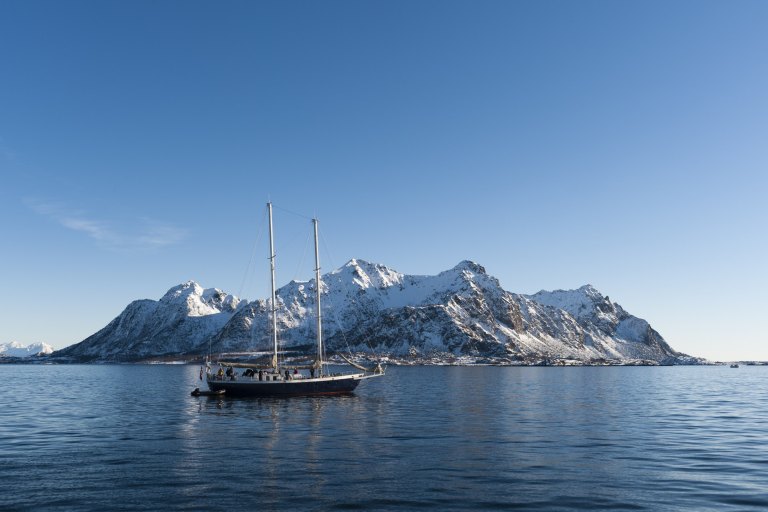
- Fleet reality: the Maldives charter fleet is motor-yacht and superyacht dominated. Sailing catamarans are scarce and usually not bookable.
- Build in buffer days: a rigid, fully-locked itinerary is the main way shoulder-season charters go wrong.
For most guests, November is the stronger shoulder-season choice for a Maldives yacht charter. It sits at the tail of the Southwest Monsoon, so wind and rain are easing rather than building, and you are heading toward the calmer, better-visibility Northeast Monsoon rather than away from it. May is the front edge of the wet season instead, and conditions there are less forgiving.
We recommend May only to guests with a specific reason to be there: early surf at North Male Atoll, or a willingness to trade some visibility and sea-state comfort for quieter anchorages and first access to the season’s building manta activity. If this is your only trip to the Maldives and you want a dependable week of diving and island-hopping across multiple atolls, November is the safer build.
Guests who ask us specifically for May tend to be repeat Maldives visitors, or surfers timing their trip to the start of the Southwest swell. First-time guests booking with no fixed reason to prefer one shoulder month over the other do better with November nine times out of ten. If neither reason applies to you, treat November as the default and only move to May if something on this page changes your mind.


May vs November: what actually happens on the water
The Maldives runs on two seasons, and May and November sit at opposite edges of the same one. The Northeast Monsoon (December to April) is dry, calmer, and gives the best underwater visibility, particularly in the eastern atolls. It ends just before May starts.
The Southwest Monsoon (May to November) brings more wind, more rain, and rougher inter-atoll crossings, but it is also the season that feeds Hanifaru Bay in Baa Atoll, a UNESCO Biosphere Reserve where manta rays aggregate to filter-feed. That aggregation peaks August through October. May is the very start of the wet season, so seas are just beginning to build and squalls are more of a coin flip. November is the other end of the same window, with wind and rain typically easing back toward the dry season that follows in December.
In practical terms, a Southwest Monsoon squall in May typically clears within an hour, but it can arrive with little warning and push wind speeds up sharply for that window. A crossing that would be a comfortable couple of hours in the dry season can turn choppy without much notice, which is why route flexibility matters more in May than it does by November, when the wind pattern is settling rather than still forming. Rain in both months tends to arrive in short, heavy bursts rather than settling in for the day, so it rarely cancels a whole day’s plan, only reshuffles it.
Which month wins for most guests
Neither May nor November is the “safe” Maldives month, that is December through April. But between the two shoulder options, November is the more bookable one for a first-time charter guest, because the trend is toward calmer conditions rather than away from them.
| Option | Best for | Not ideal for | Relative demand |
|---|---|---|---|
| May | Early SW Monsoon surf at North Male Atoll; guests chasing quiet anchorages and lower boat traffic; flexible schedules | First-time guests with a fixed one-week window and no weather buffer | Lower demand, more availability |
| November | Guests wanting the tail of manta season plus improving sea state; multi-atoll routes; divers wanting a wider visibility window than peak SW months | Guests who specifically want the mid-monsoon surf peak (June to September) | Lower demand, more availability, trending toward peak-season interest as December approaches |
In practical terms: book May if the surf or the early manta window is the actual reason for the trip. Book November if you want a shoulder-season rate and schedule with a better chance of calm crossings and workable visibility across atolls.
Because both shoulder months see less demand than the December to April high season, rates are typically softer and yachts that are fully booked in peak season have more open dates in May and November. That is useful if your schedule is flexible, but it does not remove the need to plan the route around weather. A lower rate on the wrong yacht for the season is not a good trade, and it is the single most common regret we hear about after a shoulder-season trip.
Best atolls and routes for a shoulder-season charter
Most charters start around Malé, with guests flying into Velana International Airport before boarding. From there, North Malé and South Malé Atolls are the easiest starting ground, with straightforward transfers, sandbanks, and snorkeling close to the airport. They are also the fallback zone if shoulder-season weather turns uncertain mid-trip, since the captain can shorten crossings without losing the trip.
Baa Atoll is the reason many guests choose a Southwest Monsoon month at all: Hanifaru Bay’s manta feeding is tied directly to that season, even though the heaviest aggregation is August to October rather than May or November. Ari Atoll is worth building into any shoulder-season route regardless of exact timing, since whale sharks off Maamigili run year-round and the atoll has the broadest spread of dive sites, including Maaya Thila. For guests who want fewer boats in the anchorage, the Northern Atolls, Haa Alif and Haa Dhaalu, and the south-central atolls, Vaavu, Meemu, Thaa, and Laamu, see far less charter traffic than the resort-dense central atolls at any time of year. Vaavu Atoll’s Fotteyo Kandu channel in particular is one of the more rewarding dive sites in that quieter zone, and it rarely feels crowded even in the busier months.
Transfer logistics change depending on which atolls you build into the route. Getting from Velana International Airport to a yacht based in North or South Malé is usually a short speedboat transfer, under an hour. Reaching Baa Atoll or the Northern Atolls typically adds a seaplane leg or a longer transfer by sea, and Maldivian seaplane operators do not fly after dark or in poor visibility. That matters more in a squally shoulder month than it does in the dry season. Guests set on Baa Atoll in May or November should build a buffer into the arrival day rather than scheduling a same-day yacht departure, since a delayed seaplane can push the first night’s anchorage plan back by hours.
The yacht question: why catamarans aren’t really an option here
Guests coming from Thailand or the Caribbean often ask for a sailing catamaran in the Maldives. We usually redirect that request. The Maldives charter fleet, roughly a dozen crewed vessels operating across the atolls, is motor-yacht and superyacht dominated, and cruising catamarans are scarce and hard to source here.
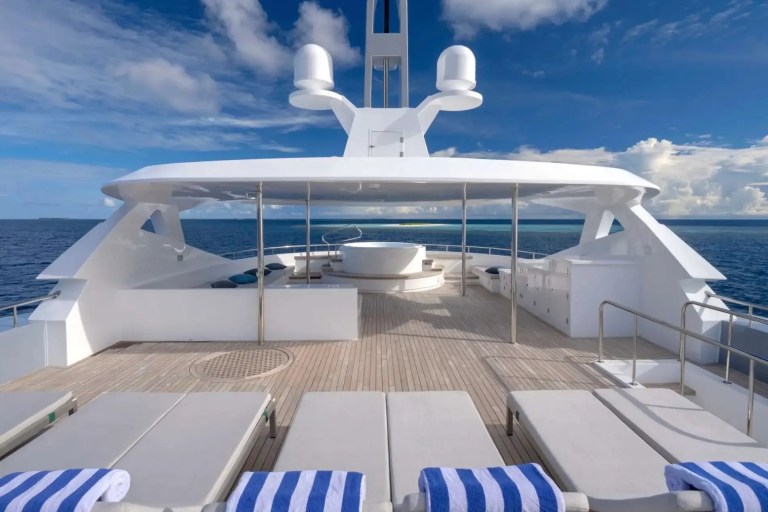
Power catamarans are worth exploring elsewhere in the group’s regions, but for a Maldives itinerary we build the trip around a crewed motor yacht or superyacht instead. That is not a downgrade for this destination. A motor yacht has the range and speed to reposition around a squall system, the stabilization to keep a Southwest Monsoon chop comfortable at anchor, and tender operations that hold up better in wind than a catamaran’s.
The choice between a motor yacht and a full superyacht usually comes down to group size and how much you want the vessel itself to be part of the trip, not the season. But in a shoulder month specifically, we weight two things more heavily than we would in the dry season: stabilizers at anchor, since a rolly night on a Southwest Monsoon swell can undo an otherwise good day, and tender capacity, since a squall can compress a group excursion into a shorter, faster window than planned. A yacht with one small tender and a large guest count struggles more in May than it would in February.
The fleet size also shapes when you should be booking. With roughly a dozen crewed vessels working the whole country, the best boats for a shoulder-season week get reserved early, especially for the atolls tied to Hanifaru Bay access. A first-time guest calling six weeks out for a November charter is choosing from what’s left, not from the full fleet.
How early should you book a shoulder-season Maldives charter?
Book a shoulder-season Maldives charter at least six to nine months before you want to sail, and earlier still if Baa Atoll or a specific vessel is non-negotiable. The fleet is small, and the yachts equipped to handle a Southwest Monsoon squall comfortably are the same ones repeat guests and dive groups ask for first.
If your trip is less than six months away, you can still get a good charter in May or November, but your choice of yacht narrows quickly, and Baa Atoll access around Hanifaru Bay is usually the first thing to sell out. We would rather quietly reserve boats for a client while they finalize dates than have them lose the right vessel to a faster-moving booking. If your trip is less than 90 days away, we usually start by checking which yachts are actually free for your week, rather than which yacht is ideal on paper, and build the route around that instead.
What goes wrong when guests book the wrong shoulder month
The most common mistake is locking a rigid, fully-fixed itinerary into a shoulder-season week. A plan built for calm, high-visibility diving in every atoll on the list is the one that gets disrupted by a single squall day. The fix is not avoiding May or November altogether, it is building the trip with a captain who can substitute a sheltered atoll or a different dive site on short notice.
The second mistake is expecting Northeast-Monsoon visibility in a Southwest-Monsoon month. Shoulder-season visibility is genuinely more variable, and a charter sold on peak-season photos of every dive site is setting the wrong expectation. The third is trip length: a single-atoll, week-long charter has less room to adjust around weather than a longer, dive-heavy itinerary, so guests chasing Hanifaru specifically should plan on the longer end.
A fourth mistake is packing and dressing for the trip as though it were the dry season. Squalls mean more layers and quick-dry gear than a December trip needs, and the wind during a squall is enough to make an open flybridge uncomfortable for an hour at a stretch. None of this changes the itinerary, but it is worth setting expectations before guests arrive assuming flat calm every single day.
- Plan 7 nights for a focused, single-atoll route; plan up to 14 nights if Hanifaru Bay or a dive-heavy multi-atoll route is the priority
- Confirm the captain’s plan for rerouting around a Southwest Monsoon squall before you sail
- Ask whether Baa Atoll’s Hanifaru Bay guide and permit requirements are already arranged, since it is a protected UNESCO Biosphere Reserve site
- Do not lock every dive site in advance; leave one or two open days
- Confirm the yacht is a motor yacht or superyacht, not a catamaran, unless the broker has specifically sourced one
- Build a buffer into arrival day if the route includes a seaplane transfer to Baa Atoll or the Northern Atolls
For more on how atoll-to-atoll routing and vessel choice shape a Maldives trip, see our broader yacht charter insights, or start with the Maldives yacht charter overview. If you are still working out logistics, our charter FAQ covers the questions that come up most before booking.
Is May or November better for a Maldives yacht charter?
November is the better shoulder month for most guests. Wind and rain from the Southwest Monsoon are easing rather than building, and conditions are trending toward the calmer Northeast Monsoon that follows in December.
Can you still see manta rays in May or November?
Yes, but neither month is peak. Hanifaru Bay in Baa Atoll sees its heaviest manta aggregation from August through October. May and November sit at the edges of that activity, not the center of it.
Can I charter a catamaran in the Maldives?
It is difficult. The Maldives charter fleet is dominated by motor yachts and superyachts, and sailing catamarans are scarce. Most guests requesting one are redirected to a motor yacht instead.
How long should a shoulder-season Maldives charter be?
Plan 7 nights for a single-atoll route, or up to 14 nights if the trip is built around diving or Hanifaru Bay specifically. Longer trips give the captain more room to work around Southwest Monsoon weather.
What is the weather actually like in May in the Maldives?
May marks the start of the Southwest Monsoon. Expect more humidity, short but intense squalls, and less predictable wind than the dry season. Rain typically arrives in bursts rather than settling in for the whole day, and an experienced captain can usually route around it.
Is November close enough to the dry season to feel like it?
Not quite, but it is close. By late November, wind and rain are easing toward the Northeast Monsoon that firmly sets in by December, so conditions are more settled than the earlier Southwest Monsoon months, without matching the calm of January or February.
Plan Your Maldives Charter With Real Experts
Tell us how you like to travel and our charter team will hand-pick the right crewed yachts, dates and route — no obligation.
Our Top Maldives Recommendations
We put these shortlists together because most travellers don’t need to weigh up every yacht on the water — just the handful that consistently get this kind of trip right. Each guide below digs into the boats, the best months to go, and the trade-offs worth knowing before you book.



















 iMessage
 WhatsApp




































